
- All
- Product Name
- Product Keyword
- Product Model
- Product Summary
- Product Description
- Multi Field Search
English
Views: 0 Author: Site Editor Publish Time: 2026-07-01 Origin: Site


TL;DR:
Solid surface technology is an engineered composite material made from acrylic or polyester resin blended with natural mineral fillers such as aluminum trihydrate. The result is a non-porous, seamless, and highly durable surface used in kitchens, bathrooms, commercial spaces, and beyond. It resists stains, prevents bacterial growth, and can be repaired if scratched.
Countertops crack. Grout lines trap bacteria. Natural stone chips. These are problems that architects, interior designers, and homeowners have dealt with for decades—until engineered surface technology changed the equation.
Over the past 20 years, solid surface has grown from a niche specification material into a mainstream choice across residential and commercial design. To truly understand what is solid surface technology and why it has displaced traditional materials in so many applications, you need to look at what it's made of, how it performs, and where it fits best.


Solid surface is a man-made composite. Unlike granite or marble, which are quarried from the earth, solid surface is manufactured under controlled conditions—which means consistent quality, predictable performance, and near-limitless design flexibility.
The core recipe combines two components:
Acrylic or polyester resin (approximately 30–35% of the total mix), which binds everything together and gives the material its workability
Natural mineral fillers, primarily aluminum trihydrate (ATH), making up roughly 65–70% of the composition, which adds density, fire resistance, and opacity
Pigments are added during manufacturing to create colors, patterns, and textures. Because the color runs through the full thickness of the slab—not just a surface coating—scratches and minor abrasions can be sanded away without leaving a visible mark. This is one of the defining advantages over laminate or painted finishes.
The versatility of solid surface materials is a significant reason for their widespread adoption. A single material can serve multiple functions across an entire project, reducing the number of suppliers a contractor or designer needs to work with.
Application | Key Benefit | Common Setting |
|---|---|---|
Kitchen countertops | Seamless joints, stain resistance | Residential & commercial kitchens |
Bathroom vanity tops | Non-porous, hygienic surface | Hotels, hospitals, homes |
Integrated sinks & basins | No crevices for bacteria | Laboratories, healthcare |
Restaurant tabletops | Durable, easy to clean | Food service environments |
Reception desks | Customizable shapes & colors | Corporate offices, retail |
Shower trays & bathtubs | Warm to the touch, watertight | Luxury residential projects |
Wall cladding panels | Consistent aesthetic, lightweight | Shopping malls, public spaces |
This flexibility is a core reason Surface Solution®, the brand manufactured by Shenzhen Letu Industrial Co., Ltd., has built a product line that extends well beyond sheets and slabs. With three independent production workshops and over 20 years of manufacturing experience, Surface Solution® covers everything from acrylic solid surface sheets to custom-fabricated sinks, bathtubs, and commercial tabletops—all from a single source.

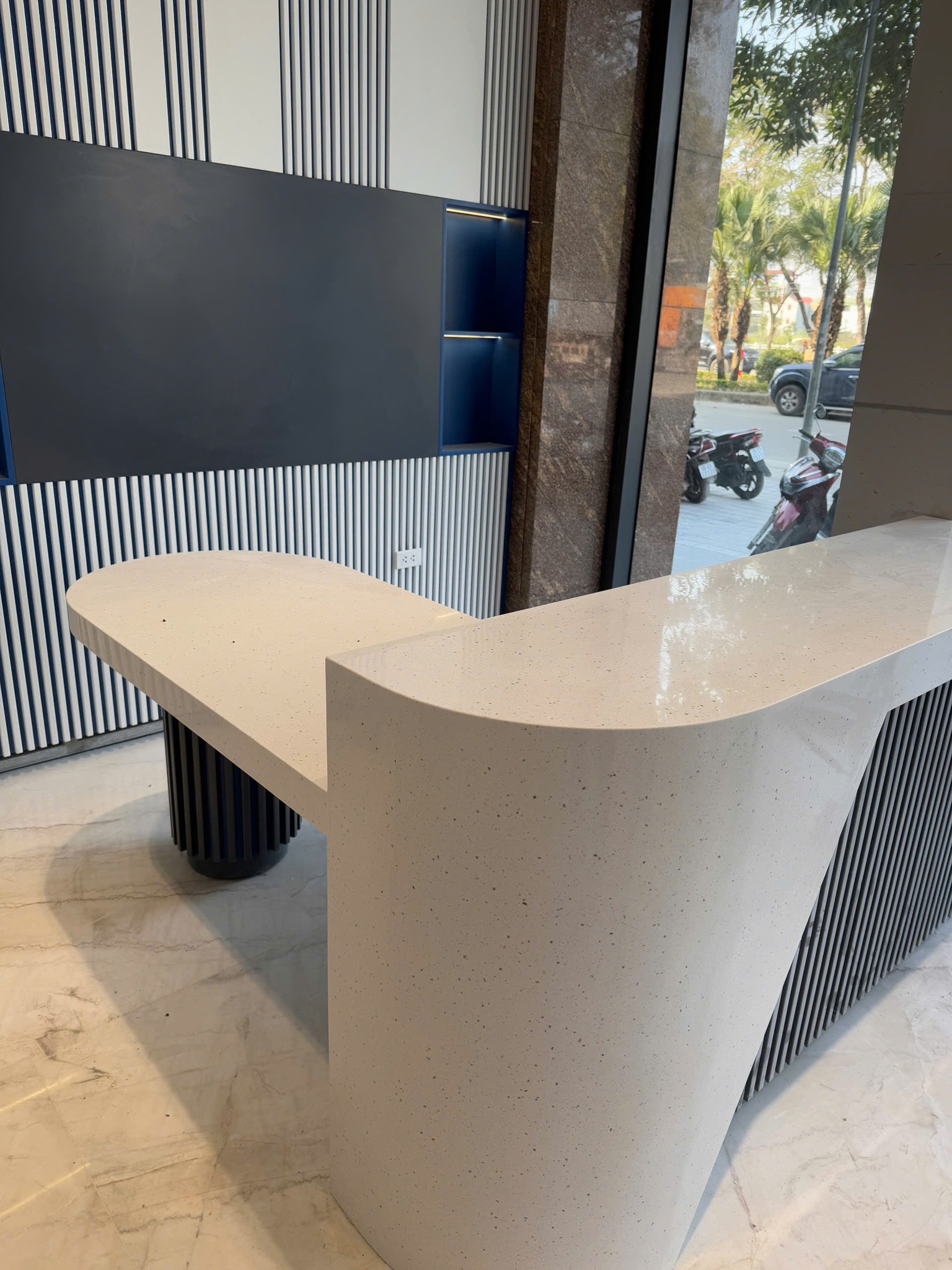
Among all solid surface applications, countertops remain the most common—and the most scrutinized. A kitchen or bathroom surface endures daily contact with heat, moisture, cleaning chemicals, and sharp objects. Material choice here has real consequences.
Choosing solid surface countertop materials over natural stone or ceramic tile offers several measurable advantages:
Non-porous surface. Unlike granite, which requires periodic sealing, solid surface does not absorb liquids. Spilled coffee, red wine, or cooking oil sits on the surface rather than penetrating it.
Seamless installation. Two slabs of solid surface can be thermally bonded so that the joint becomes nearly invisible. This eliminates the grout lines that typically harbor mold and bacteria in tiled surfaces.
Repairable. Surface scratches and minor burns can be sanded out using fine-grit abrasives. With natural stone or laminate, similar damage often means replacement.
No silica dust risk. This point has grown in importance. Engineered quartz countertops contain up to 90% crystalline silica, which poses serious health risks during fabrication. Solid surface materials, by contrast, use aluminum trihydrate as the primary filler—a silica-free alternative that makes fabrication safer for workers and specifiers alike. Surface Solution® has made this a central part of its positioning under the tagline "Zero Silica, Paving the Way for Healthier Living."
Knowing the technology is one thing. Sourcing it from a reliable manufacturer is another.
Surface Solution® operates out of Shenzhen, China, with certifications including CE, NSF, and ISO9001—credentials that matter when specifying materials for hospitals, food-service environments, or export markets. The product range covers over 300 color and texture options, developed over two decades of market research. Whether a designer needs a soft matte white for a minimalist bathroom or a bold terrazzo-look pattern for a restaurant interior, the catalog supports it.
Beyond standard production, Surface Solution® offers high-end customization. Fabricators and project teams can submit bespoke requirements—custom dimensions, integrated sink forms, thermoformed curves—and receive finished components rather than raw sheets. For architects managing complex commercial builds or developers fitting out multiple units, that one-stop capability significantly reduces coordination overhead.
Solid surface performs exceptionally well in most interior applications, but it has limits worth knowing.
Heat resistance is moderate. Solid surface can handle brief contact with warm objects but is not designed for direct contact with hot pots or pans. Trivets are recommended in kitchen applications.
It is not ideal for outdoor use. Extended UV exposure can cause discoloration over time. Solid surface is an interior material.
Cost sits above laminate, below premium stone. For most mid-to-high-end residential and commercial projects, the price-to-performance ratio is favorable, particularly when maintenance costs are factored in over a 10–15 year horizon.
Solid surface technology has earned its place in contemporary design not through novelty, but through consistent, verifiable performance. The non-porous structure, repairability, seamless fabrication, and silica-free composition address real problems that other materials have not fully solved.
Surface Solution® represents what this technology looks like when it is manufactured with rigor and designed with intent. With two decades of production experience, a certified manufacturing facility, and a customization capability that spans sheets to finished bathroom fixtures, the brand gives specifiers and fabricators a single, dependable source for projects of any scale.
To explore the full product range or request a quote, visit pstone.us.
Solid surface technology is a composite material made from acrylic or polyester resin (30–35%) combined with natural mineral fillers like aluminum trihydrate (65–70%), plus pigments. The result is a dense, non-porous slab with color running through its full thickness.
Quartz countertops contain up to 90% crystalline silica, which poses health risks during cutting and fabrication. Solid surface uses aluminum trihydrate instead—a silica-free filler. Solid surface is also easier to repair (scratches sand out), supports seamless joining, and offers more flexibility for thermoforming into curved shapes.
Yes. Because the color and composition run through the entire thickness of the material, surface scratches can be removed using fine-grit sandpaper and a polish. This is not possible with laminate or surface-coated materials.
Solid surface is widely used in commercial settings including hospitals, hotels, restaurants, laboratories, and retail spaces. Its non-porous surface prevents bacterial growth, and its seamless installation eliminates joints where contamination can accumulate. Surface Solution® products carry CE, NSF, and ISO9001 certifications relevant to commercial specifications.
Surface Solution® offers over 300 color, pattern, and texture options across its acrylic solid surface range, covering matte solids, stone-look finishes, and terrazzo-inspired designs.
For custom fabrication inquiries—including bespoke dimensions, integrated basins, or thermoformed components—contact the Surface Solution® team directly at info@surface-s.com or via the quote form at pstone.us.


